Scientific article · Sources checked October 21, 2026
From Laser-Treated Skin to Face Cream: What the GHK-Cu Trial Actually Tested
A small randomized study separated patient-rated improvement from measured recovery. Its findings matter, but they do not establish the performance of an everyday copper-peptide cream.
Editorial source review, with no clinician sign-off or firsthand treatment experience claimed.
A copper-peptide study on facial skin sounds like a natural reference for a face cream. The important question, however, is what happened to that skin before the product was applied. Research conducted after an ablative procedure tests a treatment in a recovery setting, not necessarily a cosmetic used on an intact face. That difference changes the comparison, the outcomes that matter, and the evidence needed to support a product claim.
The most useful reading of the GHK-Cu laser study is therefore neither a blanket endorsement nor a dismissal of copper peptides. It is an exercise in separating questions: Did the added regimen change measured recovery? Did participants perceive an improvement? Would either finding apply to another formulation? This analysis uses the indexed primary report abstracts for the laser and cell experiments, alongside an author-posted primary ulcer-trial full text whose optical character recognition leaves some tables uncertain.
In this article
Study facts at a glance
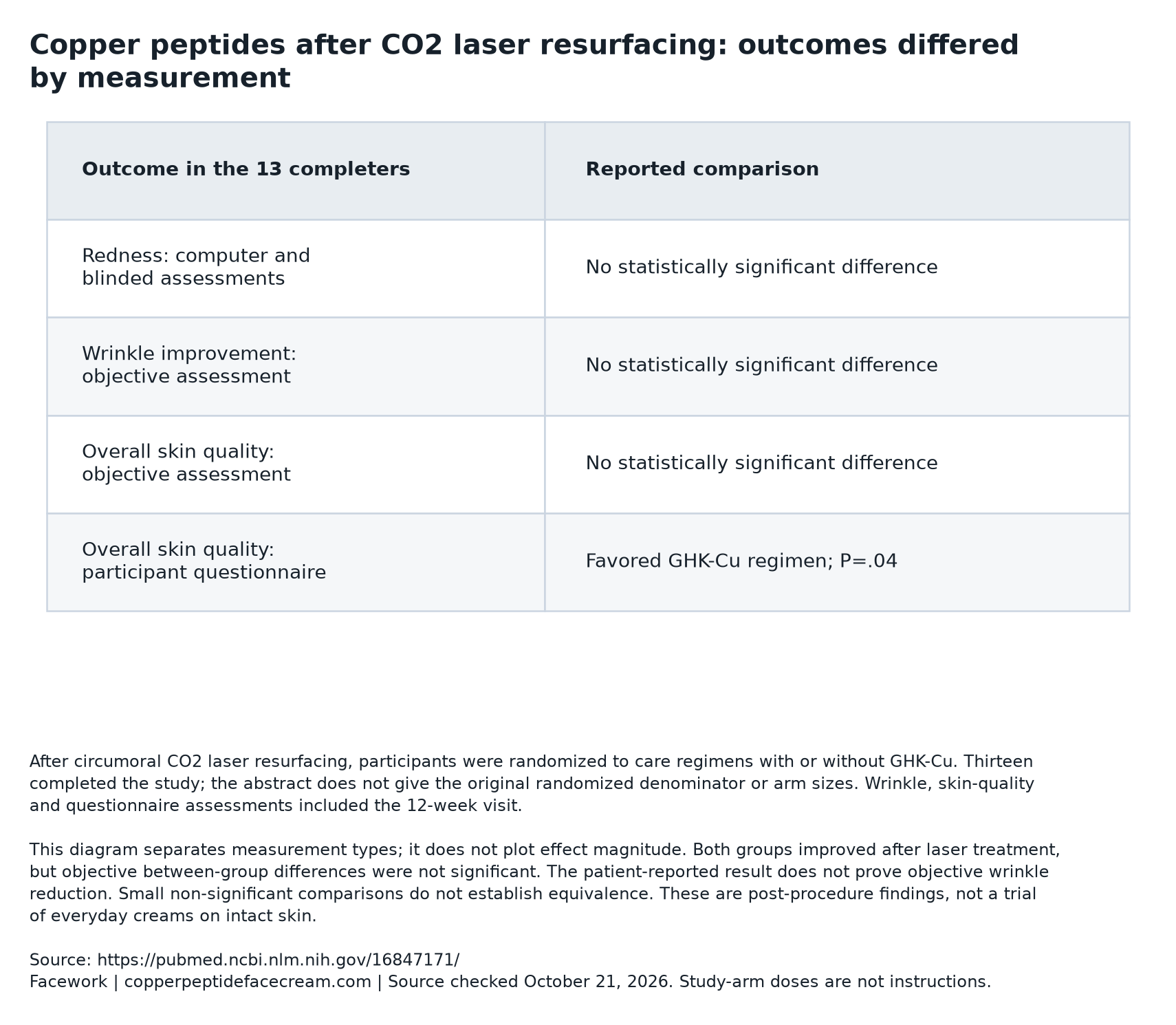
Laser-study population: Thirteen patients completed the randomized post-laser study; the abstract does not provide the starting enrollment or per-arm counts. Source 1
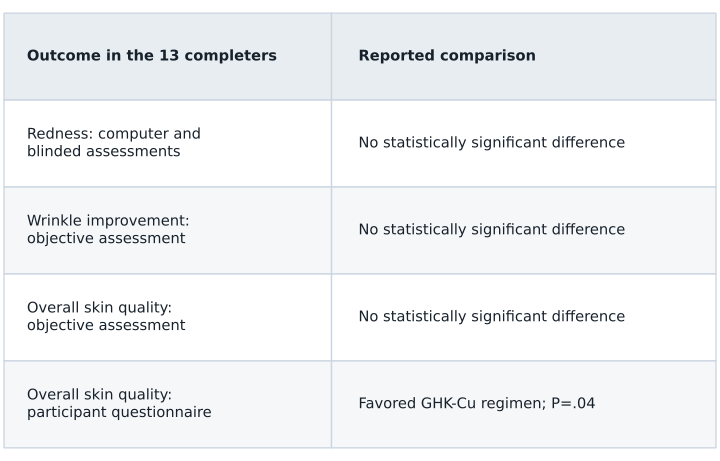
Measured outcomes: The laser abstract reports no statistically significant between-group advantage in redness resolution, wrinkles, or overall skin quality. Source 1
Patient-rated outcome: A questionnaire favored the GHK-Cu regimen, with P = .04; the abstract supplies no effect size or confidence interval. Source 1
Separate wound evidence: The diabetic-ulcer trial enrolled 181 people overall, but its immediate-treatment plantar-ulcer findings concern a narrower comparison. Source 2
Mechanistic evidence: Fibroblast experiments examine cellular responses, not whether a finished facial cream delivers a visible benefit. Source 4 Source 5
The laser comparison was an add-on test
The 2006 report studied topical regimens with or without GHK-Cu after carbon dioxide laser resurfacing around the mouth. Redness was assessed with computer analysis and blinded evaluators; wrinkles, appearance, and a validated patient questionnaire were evaluated at 12 weeks. Both groups improved after resurfacing. The abstract does not disclose the starting randomized total, arm sizes, concentration, adverse-event counts, or funding.
Methodologically, the question is the incremental contribution of the postprocedure regimen. A before-and-after photograph could show a dramatic change yet leave that contribution unresolved, because the laser itself is shared by both groups. The appropriate comparison is how much better one recovery regimen performed than the other under the study conditions. Our companion guide to copper-peptide cream after procedures develops this distinction: evidence about an adjunct should not be credited with the entire result of the procedure.
Read the underlying chart data: download CSV or download the source-labeled chart.
A small null comparison does not establish equivalence
A nonsignificant comparison means the analysis did not establish a difference at its statistical threshold. It does not mean the two regimens produced identical results. Establishing equivalence would require a defined margin for an acceptably small difference and enough precision to exclude larger differences. The accessible laser report does not provide that kind of equivalence analysis.
An illustrative example helps. Suppose two hypothetical regimens differ by one unit on an appearance scale. An uncertainty interval spanning substantial benefit and substantial harm would leave the question open; a narrow interval near zero would support a more confident conclusion of little difference. The point estimate alone would be identical. Without the laser trial's effect estimates and confidence intervals, readers cannot distinguish those situations or identify the largest benefit reasonably compatible with its data. Nor should nonsignificance be rewritten as no change over time.
Patient experience and measured appearance answer different questions
A questionnaire can capture something that image analysis misses: how people evaluate their own skin or the overall treatment experience. Conversely, a favorable rating need not demonstrate a change in the physical feature being measured. These are distinct endpoints, not competing versions of one result. The laser findings should therefore remain separated rather than combined into a single claim of improved recovery.
The reported P value is not the probability that the product worked, and it does not quantify the size of the perceived benefit. Interpretation also depends on how many outcomes were tested and how the analysis was planned; the abstract is insufficient to reconstruct those decisions. A useful future report would give the questionnaire scale, group changes, uncertainty, and a threshold for a meaningful difference. That would let readers distinguish a detectable statistical signal from an improvement large enough to matter.
Three different questions behind a favorable skincare result
| Evidence question | What would answer it | What should not replace it |
|---|---|---|
| Does recovery differ between regimens? | A direct comparison of measured recovery outcomes | Improvement after a procedure in both groups |
| Do participants perceive a worthwhile difference? | Patient-rated change with its size and uncertainty | A P value without the underlying scale |
| Are the regimens effectively equivalent? | A prespecified equivalence margin and sufficiently narrow interval | A nonsignificant superiority test |
The ulcer trial provides a different clinical experiment
The 1994 multicenter ulcer trial was randomized, evaluator-blinded, and vehicle-controlled. Participants received standardized wound care, including debridement and pressure-relieving footwear. Its immediate component tested topical 2% gel for up to eight weeks, followed by six weeks of observation. A delayed component used four weeks of vehicle before another eight weeks of vehicle, 2%, or 4% gel. These concentrations identify historical study arms, not treatment instructions.
This design offers a useful lesson about comparators. Vehicle means the formulation base without the tested active ingredient; it is not an absence of care. When both arms receive substantial background treatment, the experiment asks whether the active adds benefit to that package. Comparing the active arm with an imagined untreated wound would answer a different question and could exaggerate its contribution. The separate analysis of the diabetic-ulcer study examines this wound-care setting in more detail.
Area closure is not the percentage of patients healed
In the immediate-treatment plantar comparison, median wound-area closure was 98.5% with active gel and 60.8% with vehicle. The arithmetic difference is 37.7 percentage points between medians, not a patient-level healing probability. The endpoint used each participant's last visit, not a common 14-week assessment. Weekly tracings supplied area measurements, while longitudinal plots carried the last available value forward.
For illustration, reducing an invented wound from 200 square millimeters to 20 represents 90% area closure, even though an open area remains. A median summarizes the middle of a distribution; it does not count how many individuals reached complete closure. These distinctions prevent a striking number from becoming a different, stronger claim. They also explain why the unit of analysis matters: a whole-trial enrollment count cannot be substituted for the denominator of a restricted location-and-timing comparison.
Keeping the ulcer endpoints in their proper units
| Measure | What it describes | Invalid shortcut |
|---|---|---|
| Percentage of wound area closed | Reduction relative to the wound's starting area | Percentage of people completely healed |
| Median area closure | The middle result in the analyzed distribution | The average result or an individual prediction |
| Normalized edge-advance rate | Movement of the wound boundary expressed per day | A multiple of the number of patients healed |
| Last-visit endpoint | Status when a participant left the study | A measurement made at the same scheduled week for everyone |
Timing and missing observations complicate the wound result
Delayed gel treatment did not show a significant advantage over vehicle. The report included all participants in its analyses, including four with only a prestudy evaluation. Infection unresponsive to a week of treatment could trigger withdrawal. These features make the handling of departures relevant, even when an analysis is described as including everyone.
Carrying an observation forward makes an explicit assumption: the last recorded state stands in for later unobserved states. In an illustrative case, a partly closed wound could subsequently improve or worsen, but its carried-forward value would reflect neither development. Including a record is therefore not the same as observing the full follow-up. Likewise, different timing results raise questions about exposure conditions without proving a mechanism. Separating timing components, specifying withdrawal reasons, and reporting sensitivity analyses would help show how dependent a conclusion is on those assumptions.
Safety findings need their own endpoint boundaries
Ulcer infections were reported in 7% of active-treated versus 34% of vehicle-treated immediate plantar cases. Across the ulcer trial, overall adverse-event rates did not differ significantly. ProCyte appears in the study-product identification and author affiliations, and its development team was acknowledged; the accessible text does not establish a formal grant statement. Confidence intervals and exact adverse-event counts are not available here.
A difference in one local complication cannot be expanded into general infection prevention, just as an overall nonsignificant safety comparison cannot establish equal safety. A useful safety interpretation asks what event was counted, in whom, for how long, and with what surveillance. The laser abstract's lack of adverse-event counts leaves a separate information gap; wound-trial monitoring cannot fill it. Commercial involvement is relevant context for assessing reporting and replication, but it does not by itself establish that a result is either valid or biased.
Cell experiments support questions about remodeling
One fibroblast-culture report found increased collagen synthesis without an increase in cell number. Another found increased MMP-2 levels and messenger RNA, accompanied by greater secretion of TIMP-1 and TIMP-2. Copper ions reproduced the MMP-2 response, whereas GHK alone did not. These experiments concern laboratory cells, not clinical facial outcomes.
Fibroblasts are cells involved in connective tissue. MMPs are enzymes involved in matrix breakdown, and TIMPs inhibit such enzymes; together they make remodeling more complex than simply accumulating collagen. A plausible laboratory response generates testable questions about concentration, delivery, duration, and net tissue behavior. It does not answer them in people. In particular, exposing cultured cells directly to a substance bypasses the delivery problem that a topical formulation must solve. The moisturizer-role guide helps keep a cream's everyday purpose separate from claims about deeper tissue remodeling.
An ingredient name does not bridge skin states or formulas
The evidence spans cultured cells, chronic wounds, and recently resurfaced facial skin. None is automatically a substitute for testing a finished cream on an intact face. The missing bridge is not merely whether the ingredient appears on a label. It is whether the particular formulation produces the relevant exposure and changes the intended outcome under ordinary use.
As an editorial interpretation, a sensible evidence checklist starts with identity, formulation, application site, comparator, endpoint, and follow-up. A match on one item does not compensate for mismatches on the others. Our guide to a 2% copper-peptide label explores why a percentage alone leaves important questions unanswered. Readers comparing commercial documentation can also consult the CoreAge Rx cream review to check written formula and offer terms—not as evidence that a provider reproduces the studied regimen or results.
A more informative facial-cream trial would measure added benefit
For an everyday cream, a stronger next experiment would test the finished formulation in the intended population against an appropriate matched comparator. This is a proposal for future research, not a description of an existing study. It would prespecify a main outcome, define a meaningful improvement, report participant flow, and show between-group estimates with confidence intervals. Patient ratings and blinded appearance assessments could both be valuable if reported separately.
Duration should match the claim, and adverse effects should be collected rather than inferred from continued use. Replication would help distinguish a formulation-specific finding from a broader ingredient effect. As an editorial interpretation for purchase decisions, an evidence gap should remain visible rather than being filled with laboratory plausibility. The package-questions guide and AgelessRx cream review are places to check documentary terms and unresolved product details; neither link establishes clinical performance, condition-specific care, or equivalence to a research product.
Questions about the evidence
Should patient satisfaction count if blinded measurements do not agree?
Yes, but as a separate outcome. A patient-rated experience can be worthwhile without establishing a measurable wrinkle or redness benefit. The best report would show how large the rating difference was, how uncertain it was, and whether it exceeded a meaningful threshold. Agreement between endpoints is helpful, but disagreement should be preserved rather than averaged into a vague success claim.
Does a small study with nonsignificant findings rule out benefit?
No. It may leave important benefits and harms unresolved, depending on its precision. The opposite inference is also invalid: small size does not mean a benefit probably exists but went undetected. Confidence intervals and a clearly defined target effect are needed to judge what possibilities the study meaningfully narrows.
Why does a wound-healing result not establish an anti-wrinkle effect?
Wound closure and cosmetic appearance are different outcomes in different tissue settings. Even convincing evidence for one leaves the other question open. A transfer would require evidence connecting the formulation, exposure, population, and endpoint—not just a shared ingredient name. That is a research gap, not proof that the two applications must perform differently.
Can laboratory concentrations identify the right cosmetic percentage?
No. The concentration surrounding cells in an experiment is not the same as the concentration printed on a finished product. The latter does not establish how much reaches a relevant tissue site or remains biologically available there. Translating laboratory exposure into a cosmetic formula requires additional formulation and clinical evidence, not arithmetic alone.
Do these findings support injectable, oral, or compounded versions?
Not automatically. Route and formulation are part of the tested intervention, not interchangeable packaging choices. Results for a topical research regimen cannot establish outcomes for systemic administration or an untested compounded product. Even another topical product needs its own evidentiary bridge before inheriting claims from these experiments.
What this evidence supports
The most defensible conclusion is endpoint-specific. The laser study offers limited, mixed evidence about adding a GHK-Cu regimen after resurfacing; it does not validate routine facial creams. The ulcer experiment strengthens the case for investigating topical wound applications under defined conditions, while cell studies supply biological questions rather than cosmetic proof. For Facework readers, the practical distinction is between an ingredient worth studying and a finished product with demonstrated added benefit. Preserving that distinction is more informative than treating every positive signal as confirmation—or every nonsignificant comparison as a final rejection.
Research access and limitations
Laser and cell-study assessment is abstract-based. The ulcer analysis uses an author-posted primary full-text OCR, not a verified formatted PDF; ambiguous table arm counts and categorical proportions are therefore omitted. Protocols, supplements, and complete full texts were not available for every study. These historical reports are not current prescribing information.
Sources behind this reading
- 2006 CO2 Laser Copper-Tripeptide Study: Accessible Abstract ↗Primary study abstract only · Checked October 21, 2026
- Mulder et al., 1994: GHK-Cu in diabetic neuropathic ulcers (author-posted full text) ↗Author-posted primary full-text OCR; original table and figure layout not verified · Checked October 21, 2026
- Enhanced healing of ulcers in patients with diabetes by topical treatment with glycyl-l-histidyl-l-lysine copper. ↗Indexed primary study abstract · Checked October 21, 2026
- Stimulation of collagen synthesis in fibroblast cultures by the tripeptide-copper complex glycyl-L-histidyl-L-lysine-Cu2+. ↗Indexed primary laboratory-study abstract · Checked October 21, 2026
- The tripeptide-copper complex glycyl-L-histidyl-L-lysine-Cu2+ stimulates matrix metalloproteinase-2 expression by fibroblast cultures. ↗Indexed primary laboratory-study abstract · Checked October 21, 2026