Scientific article · Sources checked October 21, 2026
Copper-Peptide Wound Research: Measuring Closure and Assessing Relevance to Facial Creams
A historical wound-gel trial offers a meaningful clinical signal—but its measurements, treatment setting, and comparison groups do not establish benefits for an everyday facial moisturizer.
Editorial source review, with no clinician sign-off or firsthand treatment experience claimed.
Copper peptides occupy an unusual place in skincare discussions: evidence from chronic wounds often appears alongside claims about smoother, firmer facial skin. Those subjects share biological vocabulary, but they ask different clinical questions. A wound study measures recovery of damaged tissue under a treatment protocol. A cosmetic study must establish an added benefit on the skin, formulation, and outcome that consumers actually encounter.
The most useful reading of the diabetic-ulcer evidence neither dismisses it nor treats it as a shortcut to facial efficacy. It separates wound-area reduction from the number of people healed, identifies which comparison produced the result, and examines how investigators handled follow-up. This analysis uses the author-posted primary ulcer report available as imperfect full-text OCR, its indexed abstract, and indexed primary abstracts for the facial laser and cell experiments. It does not assume access to verified original tables, supplements, or complete texts for those other studies.
In this article
Study facts at a glance
Historical publication: The ulcer report was published in 1994; the later PubMed indexing record does not make it a 2006 trial. Source 2 Source 1
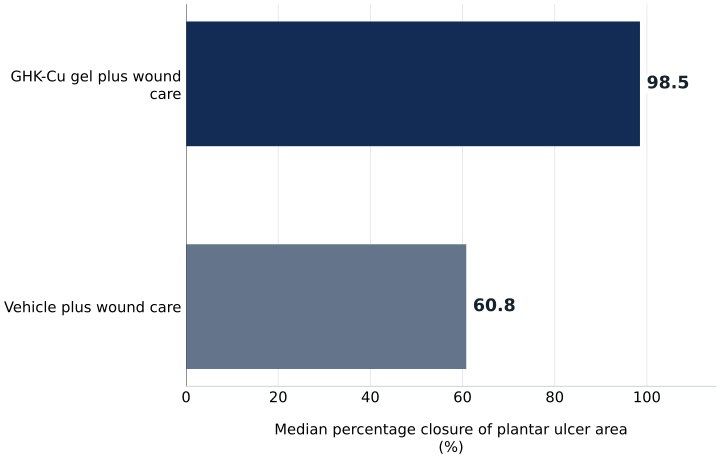
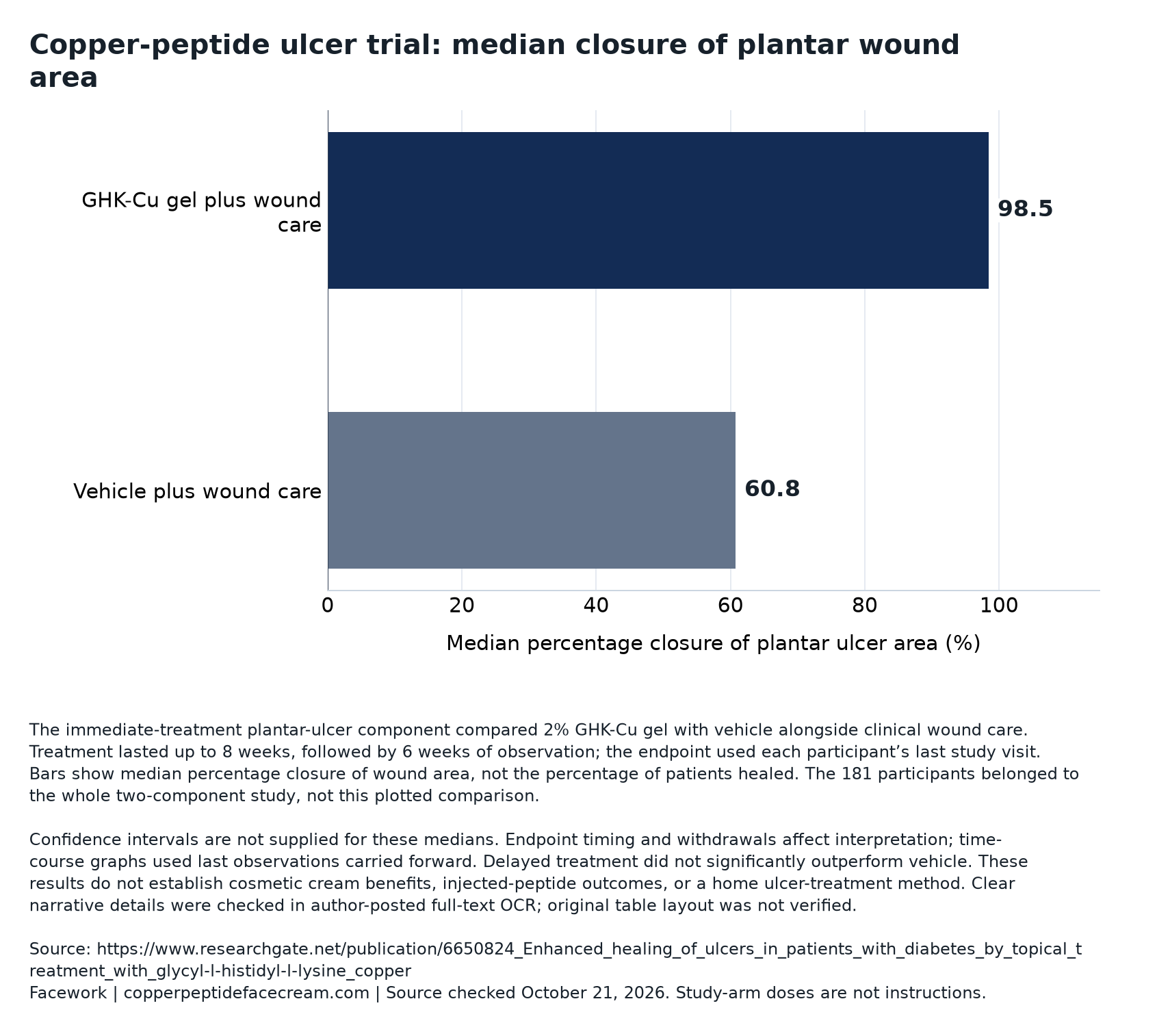
What the headline measures: The reported 98.5% versus 60.8% results are median plantar wound-area closure, not percentages of patients healed. Source 1
Which population: That comparison belongs to the immediate-treatment plantar component, not all 181 participants. Source 2
Facial evidence boundary: The small randomized post-laser study found no significant objective between-group advantage, while a patient questionnaire favored the copper-peptide regimen. Source 3
Biology versus product performance: Fibroblast experiments investigate cellular responses; they do not establish that a finished facial cream improves wrinkles. Source 4 Source 5
The experiment tested an addition to organized wound care
The multicenter ulcer study was randomized, evaluator-blinded, and vehicle-controlled. Participants had diabetic neuropathic ulcers; eligibility included adequately controlled diabetes and full-thickness below-knee wounds. All groups received standardized debridement, pressure-relieving footwear, and education. The topical comparison therefore tested an addition to care, not peptide gel against an untreated wound.
A vehicle is the formulation base without the experimental active ingredient. This comparator matters because applying a gel and participating in a structured care program are themselves parts of the treatment experience. Holding those elements reasonably consistent makes the remaining difference more informative about the added ingredient than a before-and-after photograph would be.
Randomization strengthens a causal comparison by reducing systematic differences at assignment. Evaluator blinding addresses a different problem: expectations influencing measurement. Neither feature makes the comparison universal. The relevant inference remains tied to this patient population, wound setting, and formulation—not to any product sharing the copper-peptide name.
Read the underlying chart data: download CSV or download the source-labeled chart.
Treatment timing created distinct scientific questions
The immediate component used 2% gel or vehicle for up to eight weeks, followed by six weeks of observation. The delayed component began with four weeks of vehicle, then eight weeks of vehicle, 2%, or 4% gel. These historical exposures identify study arms, not instructions for wound treatment.
An immediate comparison asks whether adding the experimental formulation at the beginning changes subsequent outcomes. A delayed comparison asks a different question because the wound has already spent time responding—or failing to respond—to the initial program. Calendar time is therefore part of the experimental context, not merely a scheduling detail.
The delayed arms did not demonstrate significant improvement over vehicle. That does not establish that their values stayed unchanged over time. It means the between-group evidence did not establish an added benefit. Nor does a difference between immediate and delayed findings, by itself, identify the biological reason: treatment timing can be clinically informative before its mechanism is resolved.
Area closure is not the probability of healing
The indexed abstract reports median area closure of 98.5% with active gel versus 60.8% with vehicle. Subtracting gives a 37.7-percentage-point difference between the reported medians. This is a comparison of wound-size changes, not a 37.7-point increase in the probability that a patient healed.
Illustrative reasoning: imagine a wound starting at 200 square millimeters. A 60% area reduction would leave 80 square millimeters open; a 98% reduction would leave four. Both describe substantial shrinkage, but neither percentage alone tells us how many people in a treatment group reached complete closure. Those are separate outcomes requiring separate counts.
A median also summarizes the middle of a distribution rather than every participant's experience. Two groups could have similar medians but very different numbers of worsening wounds. Conversely, a high median does not imply uniform success. Reading an area statistic as a patient success rate discards exactly the variation that a clinical evaluation needs to preserve.
Three different wound outcomes answer three different questions.
| Outcome | What it describes | What it does not establish |
|---|---|---|
| Percentage area closure | Change in an individual wound's surface area relative to its starting area | The percentage of participants healed |
| Median area closure | The middle result after individual percentage changes are ordered | A uniform response across the group |
| Closure rate | How quickly a defined wound measurement changes | How many additional people achieve complete healing |
Negative closure values describe an enlarging wound
For larger plantar ulcers, the abstract reports medians of 89.2% versus −10.3%. Here, negative closure means expansion relative to starting area, not a negative percentage of patients recovering. The abstract uses a greater-than-100-square-millimeter threshold; the body describes an inclusive threshold, so the exact boundary is not fully consistent.
Illustrative reasoning: using the usual percentage-area-change calculation, a wound starting at 200 square millimeters and ending at 220 would have −10% closure. This simple example explains why deterioration can generate negative numbers. Complete closure is capped at 100%, while enlargement has no matching negative limit.
That asymmetry helps explain why means and medians can diverge in wound research: a few very large deteriorations can strongly shift a mean. The abstract's −10.3% also differs slightly from the OCR body's 10.4% enlargement description. That unresolved tenth of a point should not be silently harmonized. More importantly, a stronger-looking subgroup contrast does not prove that starting size causes a different response without an appropriate interaction analysis.
Faster closure does not mean three times as many healed
The abstract describes closure as three times faster. The full report clarifies that its rate analysis used normalized linear wound-edge advance, expressed in millimeters per day. This is a geometric measure designed to compare wounds of different sizes, not a count of recovered participants.
Illustrative reasoning: suppose two hypothetical groups had edge-advance rates of 0.01 and 0.03 millimeters per day. The latter would be threefold the former, but that ratio would not reveal the proportion healed by a deadline. Starting dimensions, irregular wound shapes, deterioration, and the length of observation would still matter.
A rate ratio also does not automatically justify saying that treatment takes one-third as long. That translation assumes a stable process and comparable distances to closure. Healing can change pace. The scientifically useful interpretation is narrower: a rate calculation supports a difference in the measured trajectory, while time to complete closure and complete-healing frequency remain distinct questions.
The last visit was not a common deadline for everyone
Weekly wound tracings supplied the primary effectiveness measurements. The end-of-study endpoint used each participant's last visit, whether departure followed closure, an adverse event, or another reason. Longitudinal graphs carried the last value forward. These methods do not make every reported endpoint a measurement taken at week 14.
Carrying a last observation forward means treating the most recent recorded condition as if it persisted at later scheduled points. It keeps a graph's denominator from shrinking, but it replaces missing observations with an assumption. A wound might subsequently improve or deteriorate; the carried value cannot tell us which occurred.
This creates an important distinction between including participants in an analysis and observing every participant through a common deadline. Both matter, but they solve different problems. The OCR table layout is not sufficiently verified to publish immediate-arm denominators or categorical healing rates confidently. Confidence intervals are also unavailable, limiting assessment of how precisely the effects were estimated.
The infection finding has a narrower denominator
Reported infection incidence was 7% versus 34% in plantar ulcers treated immediately after debridement. The absolute difference is 27 percentage points within that comparison. It is not a whole-trial infection-prevention result, and it does not establish prevention of unrelated infections.
The full report found no significant difference in overall adverse-event rates. Persistent infections could lead to withdrawal after treatment failed to resolve them. Together, these details make the safety reading more specific than either 'safe' or 'unsafe': a favorable local event comparison coexists with incomplete precision about broader harms and subsequent outcomes.
A nonsignificant overall comparison is not proof of equal safety. Detecting a rare harm requires enough exposed people and enough follow-up, while an aggregate adverse-event category can conceal differences among event types. Commercial involvement also belongs in the appraisal: ProCyte affiliations, the identified study product, and the acknowledged development team are visible, although a formal funding arrangement should not be invented.
Laser-treated facial skin provides a closer but limited comparison
The randomized facial study compared post-CO2-laser regimens with or without GHK-Cu; 13 patients completed it. At 12 weeks, objective wrinkle and overall-quality comparisons did not favor either regimen significantly, nor did redness resolve significantly earlier. A patient questionnaire favored the copper-peptide regimen for perceived overall quality, with P = .04.
Objective measurements and patient reports need not agree because they measure different things. Satisfaction can be meaningful without demonstrating a measurable wrinkle advantage. Likewise, improvement after a shared procedure cannot automatically be assigned to the added skincare ingredient. The between-group comparison—not improvement from baseline alone—is the relevant test of that addition.
The abstract provides no confidence intervals, concentration, adverse-event counts, or baseline randomized denominator. A small null comparison is not evidence of equivalence. Our closer examination of the laser trial and post-procedure evidence guide explore this distinction. Even this facial study concerns recently resurfaced skin, not ordinary use on intact facial skin.
The experiments address different links in the evidence chain.
| Evidence setting | Directly studied question | Unresolved bridge to a facial cream |
|---|---|---|
| Diabetic neuropathic ulcers | Added topical gel within standardized clinical wound care | Whether another formulation improves cosmetic outcomes on intact skin |
| Post-laser circumoral skin | Added copper-peptide regimen during recovery | Whether results apply without a preceding procedure |
| Collagen fibroblast cultures | Collagen synthesis in exposed cells | Whether a finished product produces a visible human benefit |
| MMP fibroblast cultures | Matrix-remodeling responses in exposed cells | Whether those responses yield a desirable clinical outcome |
Cell experiments support a question, not a cosmetic conclusion
One fibroblast study found increased collagen synthesis without increased cell number. Fibroblasts are connective-tissue cells involved in producing the extracellular matrix, the material surrounding cells. This establishes a response in the experimental system; it does not measure facial firmness, wrinkle depth, product penetration, or consumer-perceived improvement.
A separate culture study found increased MMP-2 and its messenger RNA, alongside increased secretion of TIMP-1 and TIMP-2. Copper ions reproduced the MMP-2 effect, whereas the peptide alone did not. MMPs participate in matrix breakdown and remodeling; TIMPs inhibit metalloproteinases. The result is more complex than a simple 'more collagen' narrative.
Interpretation: tissue quality depends on coordinated production, organization, and turnover, not one laboratory marker moving upward. Exposed cultured cells bypass questions about delivery through skin and the behavior of a complete formulation. The moisturizer-role guide separates everyday product functions from these mechanistic claims, while the percentage-label guide explains why a label number cannot supply the missing clinical bridge.
A useful facial-cream study would test the finished formula
Interpretation: the strongest next step would be a controlled study of the actual facial formulation in its intended users, with a suitable comparator and prespecified cosmetic outcomes. A matched vehicle would help distinguish the contribution of the copper-peptide component from the rest of the cream. Consistent lighting, blinded assessment, and a defined follow-up deadline would make the result easier to interpret.
A useful report would also show assignment numbers, withdrawals, adherence, absolute changes, confidence intervals, and specific adverse effects. These details are not bureaucratic extras: they tell readers whether an apparent difference is precise, whether missing participants could change it, and whether perceived improvement matches measured improvement. The ulcer result cannot substitute for those observations, nor can it establish outcomes for compounded products, oral formulations, or systemic injections.
For product comparisons, the face-cream and serum guide provides a separate starting point. Interpretation for service-linked offers should remain documentary: the CoreAge Rx review and AgelessRx review are places to check written formula and offer terms, not evidence that either service reproduces trial care or outcomes. Contract clarity and clinical efficacy are different questions.
Questions about the evidence
Does almost complete median area closure mean almost everyone healed?
No. A median summarizes ordered individual area changes. A patient-healing proportion counts people meeting a defined threshold and divides by the relevant denominator. These outcomes can move together, but one cannot be reconstructed from the other. A nearly closed wound also should not automatically be described as completely healed.
Why not combine all participants into one headline result?
Pooling is only useful when it answers a coherent question. Different treatment timing, wound locations, and comparison structures can obscure rather than clarify an effect. The appropriate headline preserves the population and comparison behind the estimate instead of borrowing the larger enrollment total to make a subgroup result appear more certain.
Could the patient questionnaire be right even when objective measures were nonsignificant?
Yes. Perceived quality and measured appearance are related but distinct outcomes. A positive questionnaire does not invalidate an objective comparison, and a nonsignificant objective comparison does not erase patient experience. Neither result should be relabeled as the other, especially when effect sizes and uncertainty intervals are unavailable.
Does a matching percentage on a retail label establish equivalence?
No. An ingredient percentage alone does not identify the complete formulation, delivered exposure, stability, tissue access, or clinical setting. Equivalence would require relevant comparative evidence, not merely a similar number. Laboratory concentrations likewise cannot be converted into facial-product instructions.
What would most strengthen confidence in an everyday facial benefit?
A well-reported controlled trial of the finished product on intact facial skin would address the central gap. Prespecified outcomes, a suitable comparator, blinded measurements, participant-reported experience, and detailed harms would be more informative than additional mechanistic language alone. Replication would help determine whether the effect is dependable rather than context-specific.
What this evidence supports
The ulcer evidence supports a context-specific clinical signal worth taking seriously, not a general cosmetic endorsement. Its interpretation depends on preserving the difference between area reduction, healing frequency, and closure speed, as well as the immediate-treatment comparison and last-visit endpoint. The facial laser experiment and cell studies add relevant but different information; none closes the gap to an everyday finished facial cream. For Facework readers, the practical evidence standard is product-specific performance—not the assumption that a plausible ingredient carries every result across tissues, formulations, and uses.
Research access and limitations
The ulcer analysis uses author-posted primary full-text OCR and the indexed abstract; original table and figure layout was not verified. Ambiguous arm counts and categorical rates are omitted. The laser and cell analyses use indexed primary abstracts, not reviewed full protocols or supplements. Missing confidence intervals, incomplete harms detail, and unresolved OCR discrepancies limit precision. Historical trial reports are not current prescribing information or instructions for home wound care.
Sources behind this reading
- Enhanced healing of ulcers in patients with diabetes by topical treatment with glycyl-l-histidyl-l-lysine copper. ↗Indexed primary study abstract · Checked October 21, 2026
- Mulder et al., 1994: GHK-Cu in diabetic neuropathic ulcers (author-posted full text) ↗Author-posted primary full-text OCR; original table and figure layout not verified · Checked October 21, 2026
- 2006 CO2 Laser Copper-Tripeptide Study: Accessible Abstract ↗Primary study abstract only · Checked October 21, 2026
- Stimulation of collagen synthesis in fibroblast cultures by the tripeptide-copper complex glycyl-L-histidyl-L-lysine-Cu2+. ↗Indexed primary laboratory-study abstract · Checked October 21, 2026
- The tripeptide-copper complex glycyl-L-histidyl-L-lysine-Cu2+ stimulates matrix metalloproteinase-2 expression by fibroblast cultures. ↗Indexed primary laboratory-study abstract · Checked October 21, 2026